
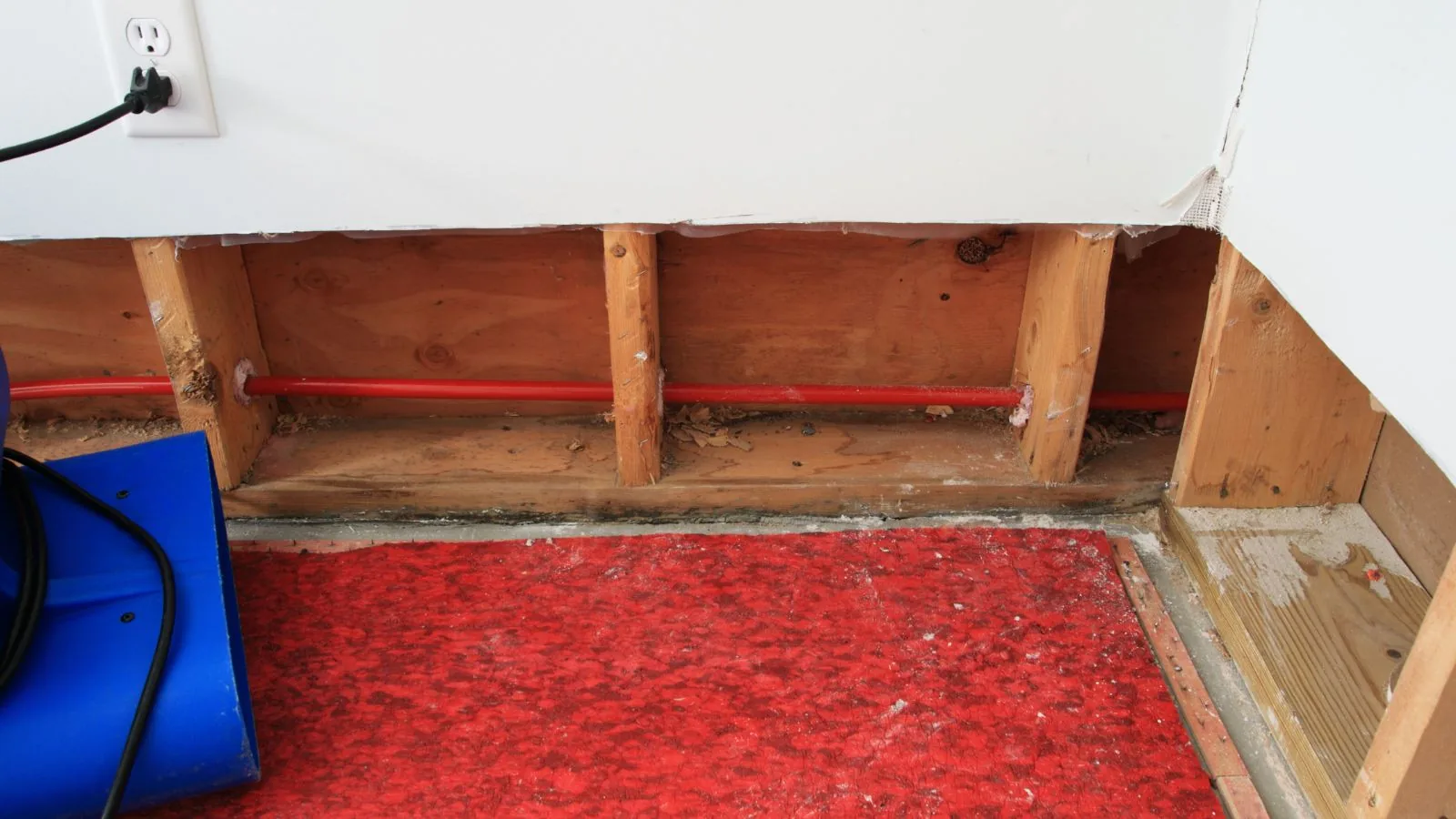
Carpet and pad act like a sponge. Water soaks the pad first, then wicks upward into the fibers and outward along the floor. If the water is clean and the carpet is extracted quickly, much can be saved.
If the water is dirty or has sat for days, the carpet usually has to go. We tell you which case you have before we start.
What to do first
Remove furniture, put foil under legs you cannot move and lift the edges of the carpet if it is safe. Do not walk on wet carpet, which pushes water deeper.
Take photos and call us so extraction can begin. Hot-water cleaners and household vacuums can spread contamination.
How water affects carpet
Wet pad
The pad holds the most water and dries slowly. It is often replaced.
Stained carpet
Dark staining from subfloor tannins can show on light carpet.
Delamination
Backing can separate from fibers after soaking.
Odor
Damp pad and subfloor produce a musty smell.
Mold risk
Pad and tack strips can grow mold if left wet.
Rust at tack strips
Metal strips corrode and stain.
Carpet in humid Lowcountry homes
In Lowcountry summers, a wet carpet in a closed, air-conditioned room dries slowly. We use air movers and dehumidifiers to pull moisture from both the carpet and the subfloor.
If the carpet is in a lower level, see basement water damage cleanup for additional steps.
Our carpet process
Extract
We remove water from the carpet and pad.
Pull back and inspect
We lift the carpet and check pad and subfloor.
Dry
Air movers and dehumidifiers run with the carpet raised.
Replace or reinstall
We replace the pad and re-stretch the carpet when salvageable.
Is my carpet salvageable?
| Water source | Carpet | Pad |
|---|---|---|
| Clean supply line, caught fast | Often saved | Often replaced |
| Clean water, over two days | Sometimes | Replaced |
| Drain or sewage water | Replaced | Replaced |
| Floodwater | Replaced | Replaced |
What affects the scope
Carpet type
Wool and synthetic fibers dry differently.
Pad quality
Foam and rebond pads react differently.
Area
More square footage means more equipment.
Water category
Dirtier water requires removal.
Carpet and claims
Insurers often cover clean-water carpet damage. Photograph the carpet, pad and any labels before removal.
Related work
A water-heater leak often wets carpet nearby, which connects to water heater leak cleanup. For standing water, see water extraction.
How we decide between saving and replacing
The decision depends on three things. The first is the water source, because clean supply-line water is very different from drain or flood water. The second is how long the carpet stayed wet, and the third is what the carpet is made of and how it was installed.
If the carpet can be saved, we extract it, lift it from the tack strip at one edge, dry the pad or replace it and reinstall. If it cannot, we remove it and dry the subfloor so new flooring starts on a dry base.
Protecting the subfloor under wet carpet
The subfloor is the part nobody sees and the part that causes the most callbacks. Plywood and concrete both hold water, and a damp subfloor under new carpet is a recipe for odor and mold.
We take moisture readings in the subfloor before anything goes back down. If the numbers are still high, we keep drying until they match a dry reference.
Stairs, bedrooms and wall-to-wall rooms
Carpeted stairs and bedrooms are common loss areas because water travels down from upstairs leaks. Stair carpet is difficult to lift, so we use extraction tools made for it and check the framing below.
Wall-to-wall carpet in a large room is a single piece, so a leak in one corner can affect the whole room. We tell you whether a section can be cut and patched or the room should be replaced.
Questions from Johns Island homeowners
Yes if the water was clean and extraction began quickly.
Usually yes. Pad is inexpensive compared to the risk of mold.
Often one to three days with equipment, depending on conditions.
Avoid it. It pushes water deeper and can spread contamination.
Odor means moisture remains in the pad or subfloor. Call us for readings.