
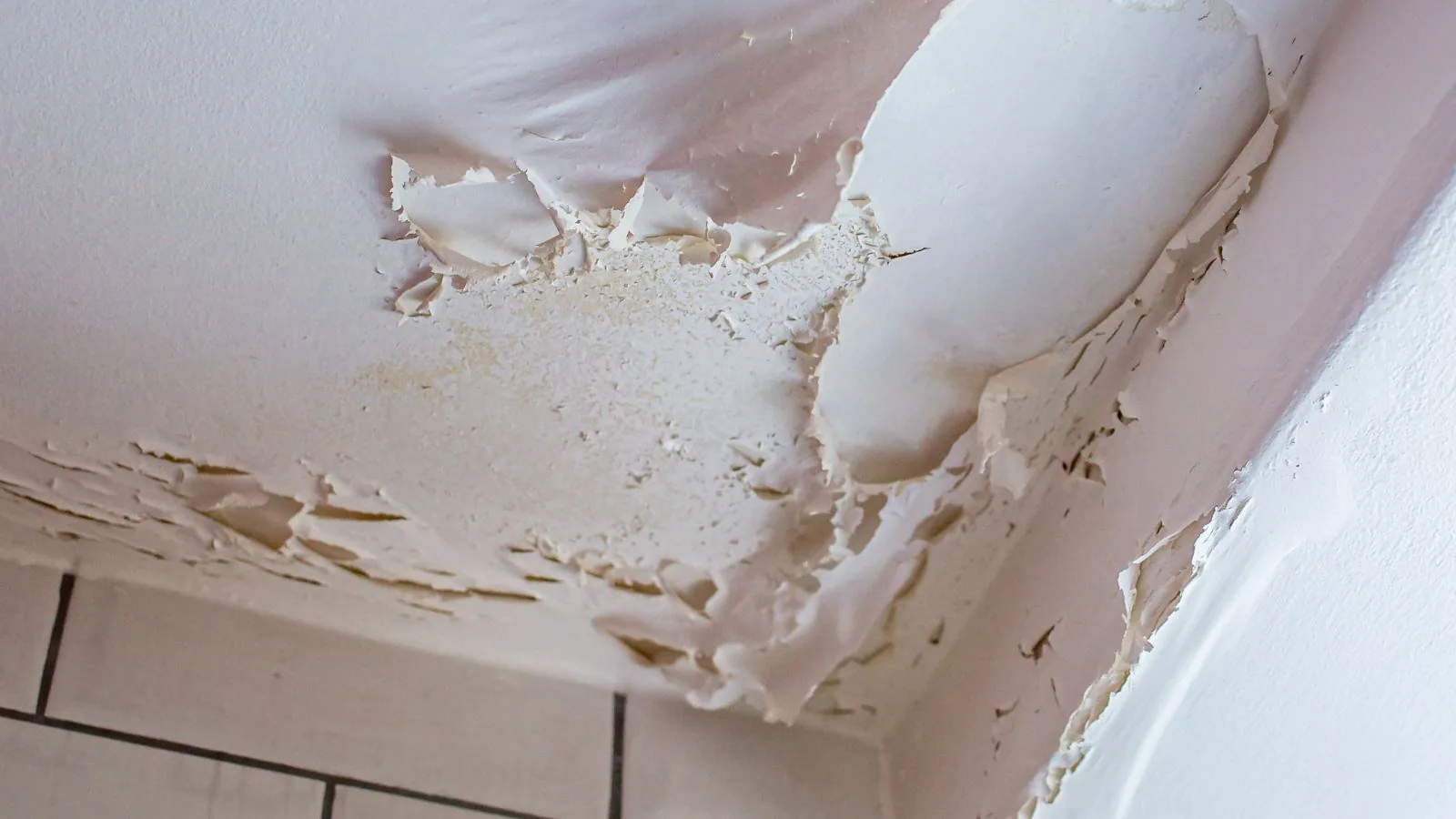
New water damage is usually damp, soft and darker, while old damage is dry, hard and often has multiple rings. But appearance alone can mislead, because old stains can get wet again and new leaks can hide. A moisture meter and a look at the source give the real answer.
Signs the damage is new
Damp or cool surface
The area feels wet or cooler than nearby surfaces.
Soft, sagging material
Drywall and ceiling tiles weaken when freshly wet.
Dripping or musty smell
Active water gives off smell and sound.
Dark, defined edges
Fresh stains are often darker and sharper.
Bubbling paint
Moisture is pushing paint off the surface.
Signs the damage is old
Dry, hard stains
Material feels firm and the surface is dry.
Multiple rings
Rings show repeated wetting and drying.
Yellow or brown halo
Old stains often fade to tan or yellow.
Cracked or peeling finishes
Paint and wallpaper lose adhesion over time.
Old mold or mildew
Dried mold may appear dusty or faded.
Why you cannot trust the stain alone
A stain can stay forever after a leak is fixed, and a dry stain can turn wet again with the next rain. A fresh coat of paint can cover either one. Only measuring moisture and tracing the source tells you what is happening now.
| Tool | What it shows | Limits |
|---|---|---|
| Moisture meter | Moisture in drywall and wood | Needs contact, reads depth only |
| Thermal camera | Temperature differences | Does not measure moisture directly |
| Visual check | Stains, texture, odor | Can be misleading |
| Pin-test of the source | Whether the leak is active | Needs access |
What to do with an old stain
If readings are normal and the source was fixed, the repair can be cosmetic. Seal the stain with primer before painting. If readings are high, find the source before anything else.
Why it matters for buyers and renters
Buyers can use readings and records to negotiate, and renters should document stains and tell the landlord in writing. Hidden damage that appears later can be expensive, so a quick check up front is a good deal.
Tracing the source
Finding where the water came from tells you more than the stain does. Look above the stain for plumbing, roof penetrations, air handlers and bathrooms. Follow the pattern of the stain, because water usually runs downhill from the source along framing.
Run fixtures near the stain and watch for new moisture. A plumber can test lines with pressure and a roofer can inspect flashing and vents. Some leaks appear only when it rains or when a particular fixture is used.
What to do with your findings
- Photograph the stain with a ruler and a date.
- Take moisture readings and note them.
- Report new damage to your landlord, insurer or seller in writing.
- Fix the source before repairing the surface.
Even if the damage is old, it may still matter for a sale, a claim or a lease dispute. A dated record protects you.
Questions to ask a seller or landlord
- When was this stain first noticed and what was done about it?
- Has the source been repaired and by whom?
- Are there invoices, photos or permits?
- Has the area been painted or patched recently?
- Has an insurance claim been filed?
Answers that are specific and documented are a good sign. Vague answers deserve a second look and a moisture reading.
How to document damage of unknown age
Take photos with the date visible on your phone, add a ruler for scale and note any smells or sounds. Record moisture readings if you can. Send the photos to yourself by email so there is a timestamp.
If you are a buyer, send the documentation to your agent and request repair or credit. If you are a tenant, send it to the landlord in writing and keep copies.
Why the age of the damage matters
New damage is often covered by insurance as a sudden event. Old damage may be treated as a maintenance issue, and a claim can be reduced or denied. That is why the age of a stain matters to the person paying for the repair.
A restoration professional can look at the pattern of damage, the condition of the materials and the moisture readings. They can describe what they see, but they are not a replacement for a licensed inspector or an adjuster who decides the claim.
What to record if you are unsure
Take dated photos, note any smell, and write down when you first saw the stain. If it grows after a rain or a shower, say so. These small facts help everyone understand what happened.
Common clues people notice first
A ring that grows after rain points to a roof or window leak. A brown stain with a musty smell often means the moisture has been present for some time. Peeling paint, bubbled drywall and a soft baseboard are other signs that the problem is not new.
Clues are not proof. The same stain can look different on different materials, and a repaired leak can leave a stain behind. A moisture meter helps separate a dry old stain from an active leak.
Coastal conditions
Salt air and constant humidity on the Lowcountry coast cause rusting, paint peeling and mildew on exteriors that look like water damage but are not always caused by leaks. Compare the inside with the outside before assuming a leak.
If readings point to a roof or air handler, see ceiling water damage repair or AC leak water damage, and we serve Ravenel and North Charleston too.
Questions we hear on Johns Island
Not reliably. Rings can suggest repeated wetting, but only readings and history confirm.
Not always. Some fresh stains look yellow depending on materials.
Only after readings are normal, and use a stain-blocking primer.
It can help, but results vary. Professional meters are more reliable.
Salt air can cause rust and peeling, which can look like water damage.